


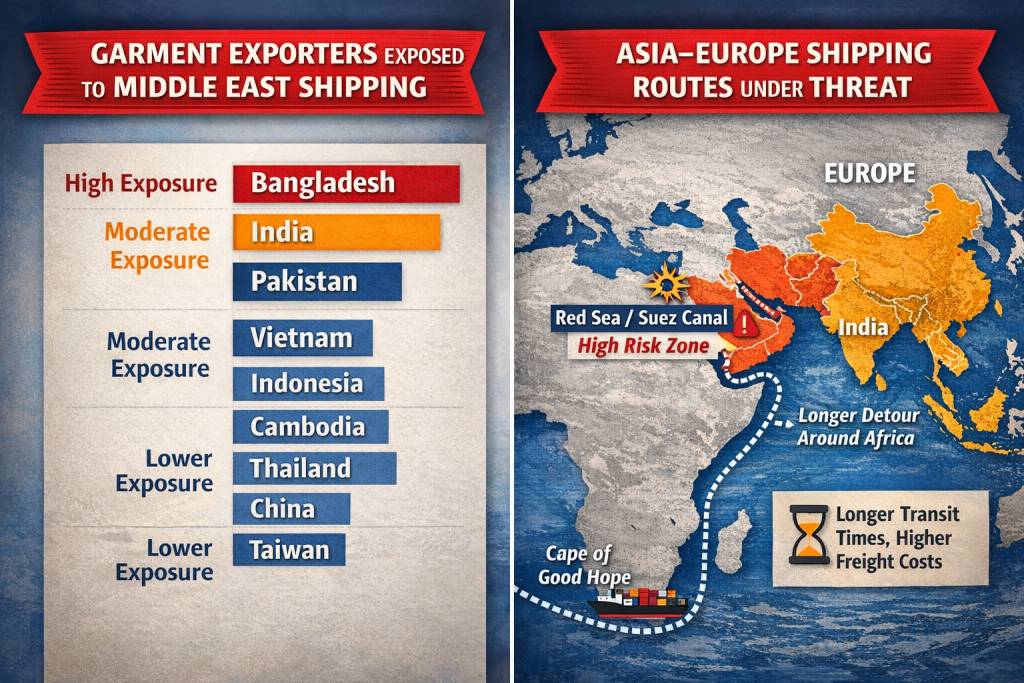
LONDON – Rising tensions across the Middle East are creating fresh uncertainty for global fashion logistics and export routes. Research by Apparel Insider shows several of the world’s largest garment manufacturing hubs particularly exposed to disruption on key shipping corridors.
For apparel supply chains, the Red Sea and Suez Canal corridor links manufacturing hubs across South and Southeast Asia with Europe. It normally represents the fastest maritime connection for containerised apparel shipments.
This is Premium Content
Only user with Online and Print subscription can access this.
If you are a Free Subscriber, click here to upgrade.
If you already have Online or Print subscription Login To Unlock The Content!
However, in recent days, major container carriers including Maersk, Hapag-Lloyd, CMA CGM and MSC have diverted vessels away from the Suez Canal and Bab el-Mandeb strait amid escalating regional tensions.
Maersk said it had paused sailings through the corridor and warned customers that vessels may instead be rerouted around the Cape of Good Hope.
“In cases where it makes most sense for our customers, vessels will be rerouted and continue their journey around the Cape of Good Hope,” the company said.
Such diversions typically add one to two weeks to Asia-Europe sailing times and reduce available shipping capacity on the route.
The countries most exposed to this disruption are Bangladesh, India and Pakistan. All three rely heavily on sea freight routes passing through the Arabian Sea and Suez Canal to move large volumes of apparel into European retail markets.
Bangladesh is particularly vulnerable because the ready made garment sector dominates the country’s export economy. Any sustained disruption that lengthens shipping times or increases volatility risks creating production bottlenecks and missed delivery windows.
India and Pakistan face similar exposure on Europe bound apparel programmes, although their broader export bases provide some buffer compared with Bangladesh’s reliance on clothing exports.
Southeast Asian manufacturing hubs including Vietnam, Cambodia, Thailand and Indonesia are also exposed, although the degree of impact depends on destination markets. These countries ship large volumes of apparel to both Europe and the United States. Shipments bound for Europe depend heavily on the Suez corridor, while US bound cargo can move via Pacific routes.
China, which remains a major apparel exporter despite declining global share, faces a similar dynamic.
Industry analysts say the security outlook will determine whether shipping companies can return to the Red Sea route in the near term.
Peter Sand, chief analyst at freight rate platform Xeneta, said any near term recovery in Suez traffic now appears unlikely.
“Any plans for a phased return of container shipping to the Red Sea in 2026 will be shelved until the security situation becomes clearer,” he said.
He added that carriers are already preparing for further deterioration in security conditions and are prioritising the safety of crew, vessels and cargo.
For fashion brands and retailers, the most immediate risk is longer transit times as well as greater unpredictability in logistics networks.
Turkey remains comparatively insulated from the disruption. Its proximity to European markets allows a significant share of apparel shipments to move by road or short sea routes rather than long haul container shipping through Suez.